Robinhood's journey from startup brokerage to S&P 500 company is one of the most instructive stories in recent fintech history. At the center of it is the GameStop short squeeze of January 2021, a moment that simultaneously made Robinhood famous, exposed serious flaws in its infrastructure, and set the stage for a chaotic IPO. For retail investors, the full arc from the Reddit trading frenzy to Robinhood's eventual recovery offers a rare window into the mechanics of modern markets, covering short selling, clearing house infrastructure, and the limits of retail brokerage access.
#How Robinhood Got Here
Robinhood (NASDAQ: HOOD) launched in 2013 with a straightforward idea to make investing accessible to everyone by eliminating trading commissions. It worked. By early 2021, the platform had grown into one of the largest retail brokerages in the US, attracting younger, first-time investors who had never used a traditional brokerage.
The pandemic accelerated that growth sharply. Lockdowns, stimulus payments, and a rising stock market brought millions of new users to the platform. By the time GameStop became a household name, Robinhood was already processing record trading volumes and quietly preparing for a public listing.
#The GameStop Squeeze and What It Did to Robinhood
In January 2021, users of the Reddit forum r/WallStreetBets coordinated a mass buying campaign in GameStop (NYSE: GME), a stock that institutional investors had heavily shorted. Approximately 140% of GameStop's public float had been sold short, meaning more shares had been borrowed and sold than existed in free circulation. The buying pressure triggered a classic short squeeze, a feedback loop where rising prices force short sellers to buy back shares at a loss, pushing prices higher still.
GameStop's share price hit a pre-market value of over $500, nearly 30 times its $17.25 valuation at the start of that month. The hedge funds caught on the wrong side of the trade suffered catastrophic losses. Melvin Capital alone lost approximately $6.8 billion, representing 53% of its assets under management, and required a $2.75 billion emergency cash infusion from Citadel Securities and Point72 just to keep operating. The fund never recovered and shut down in May 2022, with clients losing around 57% of their initial investments.
For Robinhood, the surge in trading activity created a different kind of crisis. The volume of GameStop transactions meant the company faced a collateral shortfall at the Depository Trust and Clearing Corp (DTCC), the clearing house that sits between buyers and sellers in every US equity trade. On January 28, Robinhood halted buying of GameStop and several related stocks. The stated reason was an inability to post sufficient collateral at the clearing house to execute client orders. Users could still sell their shares, but not buy new ones.
The asymmetry caused GameStop's price to collapse as retail holders sold in panic. The backlash against Robinhood was swift and came from across the political spectrum. Class-action lawsuits were filed within days. The House Committee on Financial Services convened a hearing on February 18 where lawmakers questioned the CEOs of Robinhood, Melvin Capital, Citadel, and Reddit about their roles in the events. CEO Vlad Tenev testified that the halt was a direct result of the DTCC's collateral demands, not a decision made to protect hedge funds. Internal documents later surfaced in litigation showing executives in financial panic during the halt, in tension with the measured public messaging.
Despite the controversy, the episode drove enormous brand awareness. Millions of new users signed up in the weeks that followed, drawn by the coverage.
#The IPO: High Expectations, Weak Debut
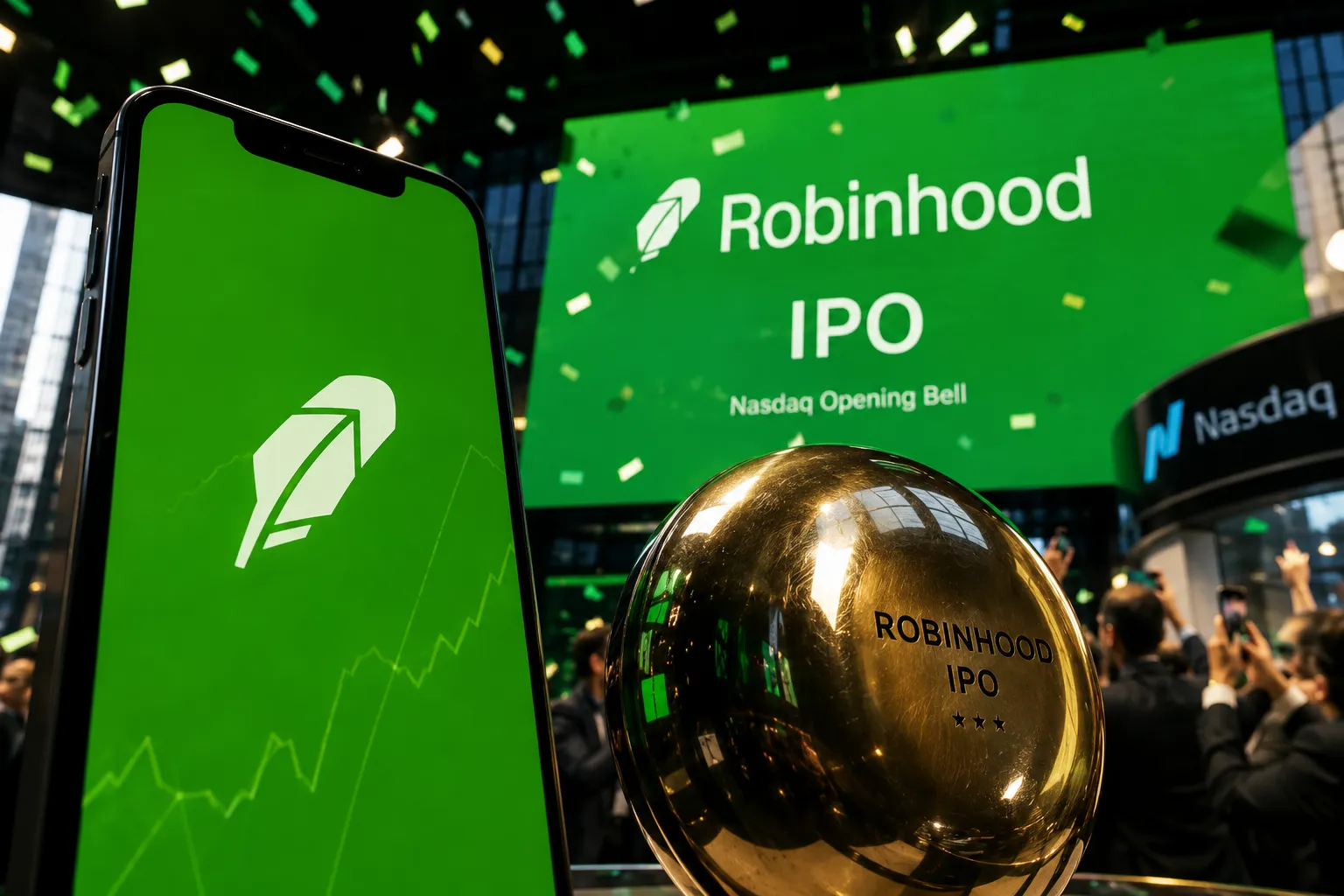
Robinhood filed its S-1 with the SEC in the summer of 2021 and priced its IPO in July. The company made one distinctive decision. It reserved between 20% and 35% of its IPO shares for its own retail customers, one of the largest retail allocations in IPO history, a move designed partly to repair the trust it had damaged in January.
Shares priced at $38, the low end of the range, and fell more than 8% on the first day of trading, closing at $34.82 and giving Robinhood a market capitalization of roughly $29 billion. The debut was widely described as one of the worst among large IPOs that year. The irony was hard to miss. A company built on democratizing market access had its own public debut rejected by the market.
The stock briefly hit an all-time high of $85 in August 2021 as retail traders, many of them Robinhood users, turned HOOD itself into a meme stock. That spike faded quickly. By mid-2022, HOOD had fallen more than 75% from its IPO price and nearly 90% from its all-time high, hammered by a collapsing crypto market and a sharp decline in retail trading volumes.
#The Recovery and What Robinhood Became
The post-IPO slump turned out to be the low point rather than the end of the story. Robinhood used the difficult period to diversify its revenue streams and expand its product offering beyond stock and options trading into cryptocurrency, retirement accounts, credit cards, a desktop trading platform, and eventually prediction markets.
By 2024, transaction-based revenues had fallen from roughly 75% of total revenue to around 56%, reflecting a more mature and diversified business. In 2025, Robinhood reported record full-year revenues of $4.5 billion, record diluted earnings per share of $2.05, and net deposits of $68 billion.
The company joined the S&P 500 on September 22, 2025. Measured from its IPO to its S&P 500 inclusion in September 2025, HOOD significantly outperformed the S&P 500, though the stock has since pulled back from those highs. As of Q1 2026, Robinhood held $307 billion in total platform assets across 27.4 million funded customer accounts.
#What the Robinhood Story Reveals About Retail Investing
The GameStop episode and the Robinhood IPO together expose several mechanics that every investor should understand.
Clearing house infrastructure shapes what you can do. Most retail investors have no visibility into the settlement system that sits behind every trade. The two-business-day settlement window (T+2, now shortened to T+1 following an SEC rule change in 2024) creates collateral obligations for brokerages that can, in extreme conditions, override their obligations to customers. Knowing this exists is part of understanding the limits of retail brokerage access.
Platform risk is not theoretical. The trading halt showed that access to markets through a retail app is conditional, not unconditional. Brokerages operate under capital and regulatory constraints that can restrict your ability to trade at exactly the moment you most want to.
Momentum trades carry asymmetric risk. The investors who made money in the GameStop squeeze were early movers who sold into the rally. Those who followed media coverage into the trade near the peak absorbed severe losses when the price collapsed. The same pattern repeated when HOOD itself became a meme stock in August 2021.
Business fundamentals reassert themselves over time. Robinhood's share price tracked sentiment, controversy, and crypto cycles for years before its underlying business results began to drive the stock. The recovery was built on revenue diversification and profitability, not on the notoriety of 2021.
#FAQs
#What caused Robinhood to halt GameStop trading?
Robinhood halted buying of GameStop on January 28, 2021 because it could not meet the collateral requirements set by its clearing house, the DTCC, given the volume of trades it was processing. The company raised $3.4 billion in emergency capital within days to restore normal trading. The halt was not found to be illegal, though it generated significant regulatory and congressional scrutiny.
#Was the Robinhood IPO a failure?
The IPO debut was poor by most measures. Shares priced at the low end of the range and fell 8% on day one. From its IPO to its S&P 500 inclusion in September 2025, HOOD significantly outperformed the broader market, though the stock has since pulled back from those highs. The IPO was a weak debut for a company that ultimately built a stronger business than its 2021 valuation suggested.
#Did retail investors win the GameStop short squeeze?
Outcomes varied entirely by timing. GameStop shares hit nearly $500 at their peak. Early buyers who sold near the top made substantial returns. Those who bought during peak media coverage and held were left with significant losses as the stock collapsed back toward fundamental value. The hedge funds with short positions lost billions, but most of those losses were absorbed by institutional capital rather than being redistributed to retail traders.
#What is a short squeeze?
A short squeeze occurs when a heavily shorted stock rises sharply in price, forcing short sellers to buy back shares to cover their positions. That buying pressure pushes the price higher, which forces more short sellers to buy, creating a self-reinforcing cycle. The result is a rapid price spike driven by mechanics rather than changes in the company's underlying value.